Tuesday, February 17, 2015

The Lenten Fast (why it matters and what you can do about it)

Beginning this Wednesday, more conversations than not on the Notre Dame campus will begin with the words, “So what are you giving up this Lent?” Lots of people will be posting peace-out-see-you-soon FaceBook statuses (“Be back in 40 days!”), enjoying their last sweets for a little while on Fat Tuesday, and renewing their workout or sleeping commitments.

All of this is fine and good, but so often we don’t do justice to the real meaning behind the act of giving something up for Lent.

The forty days of Lent are not recognized arbitrarily. One of the earliest stories we know about Jesus is that of his temptation for 40 days and 40 nights in the desert (see Matthew 4). Jesus was hungry, thirsty, dirty, and tired during this time, and on top of all these human struggles he was tempted three times by the devil. It took an immense death to self and reliance on God the Father for Jesus to overcome this trial.

During Lent, the individuals of the Body of Christ are called to enter into Jesus’ self-emptying in a special way through prayer, fasting, and almsgiving (see Campus Ministry’s Lent FAQ page for more information on Lenten practices).


In an accomplishment-driven culture such as ours, it is easy to fall into the idea that Lent is a time for improving ourselves. But this is a sort of disoriented desire. The practices of prayer, fasting, and almsgiving during Lent help us to allow things in ourselves to be crucified. So, what’s the best way to choose something to give up for Lent, now that the stakes are higher and this practice means a little more than self-improvement? 

Consider these scenarios:

Do you give up Instagram to save yourself time (self-actualizing), or do you give up Instagram to prevent yourself from the prideful/vain practice of refreshing the page incessantly after posting a picture to track the number of likes you get (self-emptying)?

Do you read scripture for 15 minutes every night during Lent just to speak to your friends about it and to check that box off the list (self-actualizing), or do you make this a personal habit in order to put yourself in a prayerful, right mindset at the close of every day while taking 15 minutes out of your social media routine during the day (self-emptying)?

Instead of giving up stress drinking to make yourself healthier (self-actualizing), give up an hour or two on Sunday night that you “study” – reserve those for Mass, prayer, etc., and be more efficient in your studying on a regular basis (self-emptying). 

Etc…

Lent asks us to put on a level of self-reflection that we might not have given time or attention to the rest of the year. The practices of prayer, fasting, and almsgiving are guides that allow us to enter into the desert with Jesus (we have focused on fasting in this post, but we can also incorporate prayer and almsgiving into our Lenten promises).

If we’re going to the desert, we’re going to the Cross, too. We allow our disordered desires to be crucified during Lent, so that with Jesus we might say, “Father, if you are willing, take this cup from me; yet not my will, but yours be done” (Luke 22:42).


Monday, February 9, 2015

On Islands: Grieving and Moving Forward

As our campus grieves the loss of Daniel Kim, a fellow student at the University of Notre Dame who passed away this weekend, I am left reflecting on grief. It’s such a universal human emotion – we have all grieved at some point over some one or some place or some thing – and yet it can be such a personally isolating, desolate place to settle. You can “share your grief” with others and yet feel utterly alone.

Grieving is not just sadness. It can be. But it can also contain anger, frustration, joy, laughter, confusion, denial. It may involve a revival of faith or a wavering of faith. It can make the griever feel big and significant or small and inconsequential. Grieving is an acute sense of loss which can be accompanied by the entire spectrum of possible human emotions.

And sometimes, especially if we haven’t grieved in a while, we forget that all of this is wrapped up in the process.


January 21 was the one-year anniversary of the death of a high school friend and classmate of mine. One of my friends on the ND campus, who also lost a high school classmate during her freshman year of college, recently shared an important perspective with me. When we grieve for some one, we don’t have to try to move on. That’s impossible, and it simply doesn’t do justice to the life lived. Instead, the process we must embark upon is the process of first beginning to heal, and then moving forward – remembering, keeping in mind, and carrying with.

It took the event of my friend’s death and the subsequent intense despair and isolation that plagued me for a while to recognize what a communal experience grief can be. I felt like an island after receiving the news of my friend, separated by miles upon miles and states upon states from the others who knew and loved him. But once I turned to my family of friends on campus, I tapped into a community of support and love that I didn’t realize was necessarily so real and present before. I found a safe place to heal in the people right around me.

The dichotomy between needing to be alone and yearning for community during a time of grief can be exemplified through David Weale’s Introduction to his book Chasing the Shore:

“What I call my ‘self’ appears most days to be a very small island in an immense ocean, but I have discovered that what seems to be separate is not separate at all, but is connected beneath the surface of consciousness to all that is…we are all the tips of a concealed greatness that is, most of the time, beyond our abilities to discern…for those with eyes to see it turns out to be a place of infinite extension, and a portal to the eternal…”

I have discovered that the “concealed greatness” which Weale speaks of is God’s deep, unwavering love for humanity. It is this love that connects us all, from creation through life and death and into eternity. It is this love that grounds us, even amidst intense grief. It is this love that offers us a point of orientation to stand on as we start the process of healing, as islands connected within a community. Together, we begin the process of moving forward.


Monday, February 2, 2015

Retreat High…Why?

Retreat. What comes to mind in the context of this word? The best weekend of your life? The time when you felt most out of your comfort zone? Something foreign and scary? Something foreign and uninteresting? I’ve heard all of these responses and more in conversations with friends and acquaintances about retreats.

Some people love ‘em, some people don’t consider themselves “retreat people,” and some are indifferent. But no matter your stance on the matter, if you are reading this you have most likely been exposed to retreat culture in some capacity.

Regardless of the individual theme of a retreat, the length of time spent retreating, or the specific activities participated in, a retreat is typically designed to be an “escape” from “normal life” with the goal of powering off, focusing up, and working towards a goal. In the context of a religious retreat, this goal is typically to refocus on one’s relationship with God. On many Notre Dame retreats, both silent reflection/prayer time and communal small group time help to accomplish this strengthening, deepening, and renewal of faith. By looking for support in the Church around us, we are able to better engage in our personal spiritual lives and vice versa.

My Sophomore Road Trip retreat family from this past September
Many of those who answered “the best weekend of my life” to my original question can relate to the phrase “retreat high” – that incredible, floating-on-air-on-top-of-the-world-everyone-and-everything-is-awesome-and-life-is-perfect-and-people-and-especially-God-are-so-so-so-good feeling that accompanies many retreatants through an experience on Notre Dame- (and Jesuit-; shout-out to my Crusaders) esque retreats and follows them home. But how does one sustain that potential retreat high?

Welp. Bad news, folks. You don’t.

…to a certain extent. Retreat highs are incredible; don’t get me wrong. I have been on and led many, many retreats, and the feeling of being high on life and God and friends and fellowship has never and will never get old. But whether one experiences a “retreat high” or not, “real life” gets in the way (in the best way possible). Life isn’t perfect, and neither are people – especially me. Here’s where the good news comes in. God is. God is perfect.

So while retreat highs gradually (or abruptly) transition back into the highs and lows of everyday life, the really cool thing about such experiences is that they hopefully give us the opportunity to slow down and remove ourselves from our general busyness and human worries enough to catch a glimpse of ourselves and others in light of God and in light of His love.

That’s the real retreat high and the real retreat secret. What we bring home from retreats, and what we’re called to “bring home” in every day life (regardless of whether we have participated in zero or ninety nine retreats) is what we pray for in the Our Father: “Thy kingdom come, Thy will be done, on earth as it is in heaven.”

On earth as it is in heaven.

Tuesday, January 27, 2015

The Physical Church: Beauty and Intentionality

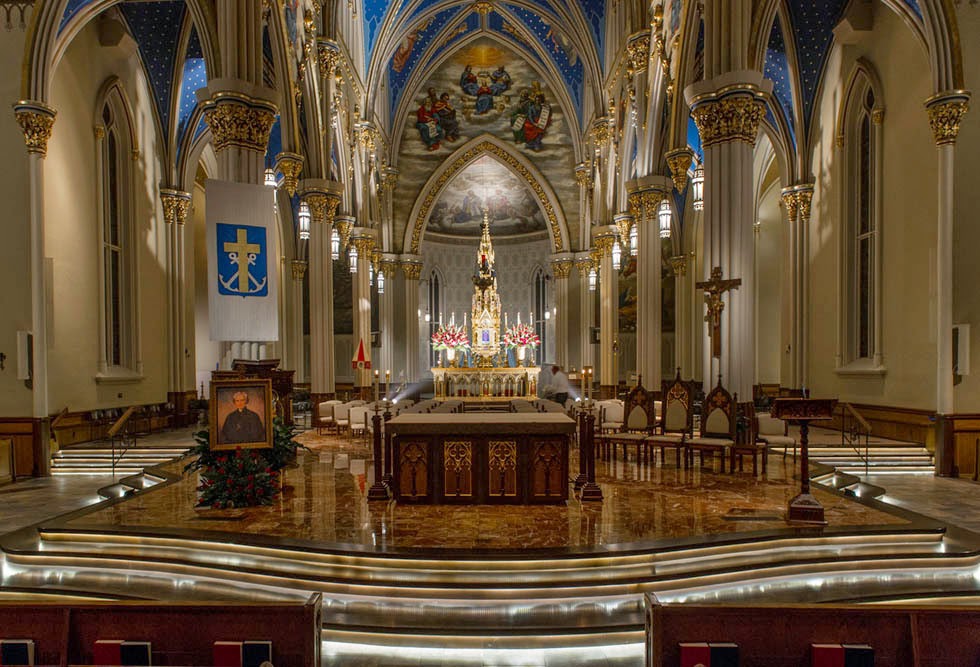
The Basilica of the Sacred Heart on the Notre Dame campus is breathtakingly gorgeous. Basilica Mass is packed both on football weekends and during daily Mass, faithful from all over the world make pilgrimages to the Basilica every year, and it is rumored that the wedding waiting list is years long.

We are incredibly blessed to have the opportunity to worship in such a beautiful space. A particular feeling of peace overwhelms me when I step through the massive front doors; the calm brought on by the stunning murals, the certain scent of incense, and the hushed whispers remind me that I am very much in the presence of God. What makes a space like the Basilica so conducive to this overwhelming recognition of the presence of Christ? This week I had the opportunity to speak with the rector of the Basilica of the Sacred Heart, Father Peter Rocca, C.S.C. Let’s explore what he has to say about the layout of the Basilica and other Catholic churches and why we worship in the spaces that we do…

Picture from Notre Dame Campus Ministry
Our line of sight and the Sacraments of Initiation

In the main entrance to the Basilica stands a water font. This is filled with holy water and symbolizes the sacrament of Baptism, an event that marks the entrance into Christian life. The sacrament of Baptism is the gateway to the altar and the reception of the Eucharist, so the placement upon immediate entrance to the church is fitting. When Catholics enter the church, we dip our hands in this holy water (there may be smaller holy water “stoops” in chapels and churches) and make the Sign of the Cross, reminding us of our Baptisms. (Fun fact: the wooden part of the font in the Basilica is from the font Father Sorin built!)

The next “big thing” we run into on our way into the Basilica is the ambry. This is a beautiful case that holds the holy oils: Chrism, Oil of Catechumens, and oil for anointing of the sick. These oils are used in Baptism (Chrism) and Confirmation (Oil of Catechumens), adding one more sacrament of initiation represented by the physical entrance into the church.

Finally, as we walk around the holy water font and past the ambry down the center aisle, we see the altar directly in front of us. This is where the liturgy of the Eucharist occurs and where we gather together as a family to share in and “give thanks” (Eucharist) for the gift of Christ. All three of the sacraments of initiation are represented in our literal walking into the Basilica, which reminds us of our choice to “walk into” our chosen way of life as Catholic Christians.

Picture from ttamba.wordpress.com
Three focal points

There are three main focal points at the front of the Catholic church: the altar, ambo, and presider’s chair. These are the three locations where most of the action takes place during Mass. The altar is the table of the Eucharist, the ambo is the table of the Word, and the presider’s chair is where the priest stands for the majority of Mass, leading the congregation through the Liturgies of the Word and the Eucharist.

Additionally, all Catholic churches should have one principle crucifix, or a cross portraying the crucifixion of Christ, at the front and visible to the congregation.

Picture from The Daily Domer
The Tabernacle

One of the most important elements of any Catholic church is the tabernacle. This is where the consecrated Eucharist is stored, or bread that has been transformed into the Body of Christ through the process of transubstantiation, which takes place during the Liturgy of the Eucharist. The tabernacle in the Basilica is particularly stunning. The tabernacle and a sacrament tower make up the altar of reservation, which fills the space in the Basilica beautifully. The tower is designed after Revelation 21, which portrays the vision of the heavenly New Jerusalem. The tower is twelve-sided, representing the twelve gates to the New Jerusalem, each side inscribed with the name of one of the twelve apostles and complete with an angel (see Revelation 21). The tabernacle area in any Catholic church where the Blessed Sacrament is reserved is complete with a sanctuary lamp, which burns constantly before the Blessed Sacrament within the tabernacle to indicate the real presence of Christ in the Eucharist.

Picture from blogs.nd.edu/oblation
Picture from The Spirit of Notre Dame by Dorothy Corson
The atmosphere: stained glass windows and murals

One of the most notable features of the Basilica are its rather innumerable stained glass windows and spectacular murals on the walls and ceiling. The images in both of these mediums largely depict angels and saints: holy men and women. As Catholics, we believe that these men and women participate in the Mass. Just before we sing the “Holy, Holy” during the Liturgy of the Eucharist, the presider might say, “And so, with the Angels and all the Saints we declare your glory, as with one voice we acclaim” – so we, as a people of faith, actually join in the worship of the angels and saints, real men and women who have gone before us.

Many churches are decorated with stained glass windows and murals, and many portray saints. These holy men and women serve as role models, intercessors (we ask them to pray for us, just like we would ask a living family member or friend to pray for us), and members of the heavenly assembly whom we join in worship.

Picture from Stephen S.'s flickr
Picture property of Luigi Gregori

Next time you’re in the Basilica or any church, keep the elements of the physical church and the intentionality behind them in mind. The layout of any church is significant, from furniture to decorations, and we only covered a small portion of those in a Catholic church in this post. The Basilica is a great example of extreme attention to beautiful detail when it comes to worship spaces. For an online tour of this beautiful church, click here!

Tuesday, January 20, 2015

reNEWing your faith in the New Year

Happy 2015, friends! Let’s get this party started.

I’m not really one for making New Years resolutions. Why? Because I’m more into goals. And lists. Okay, so maybe it’s just a difference in wording. But in any case, I have a list to share with you this week…

The following is a list of fifteen suggestions (because 2015) of concepts to consider, activities to try, and events to attend in the New Year in order to enrich our faith lives. They are in no particular order. If you already do these, great! If you don’t, give some or all of them a try. Not all of these will “work” for everyone – but you’ll never know if you don’t take a risk. Let’s embark on this journey together, assume responsibility for our relationships with God, and learn a little bit more about ourselves and our faith:

1.  Take time to breathe.
All elements of our lives will be more in balance if we take time daily to re-center (as a 50% extrovert, 50% introvert, I can especially relate to this point). Recently I heard a suggestion to stop into the chapel in our dorm for two minutes of quiet reflection every time we pass it. This can be done with a “prayer corner” in a house or an apartment, too. Give yourself the gift of quiet time with God in the midst of busy days.

2.  Pray the Rosary.
Do it on your own, with old friends, or with new friends at the Grotto (the Rosary is said every evening at 6:45). See page 60 of the new Notre Dame Prayer Book or this link to a guide of this awesome Catholic prayer. 

3.  Engage in conversation with a priest or a nun. Or multiple. Enough said.

4.  Try out evening prayer.
On Notre Dame’s campus, Vespers is celebrated at 7:15pm every Sunday evening in the Basilica.

5.  Go on retreat.
Notre Dame offers several retreats in the spring, including the All-Class “Take Time” retreat on February 6-8 and the Silent Retreat on February 27-March 1. See the Campus Ministry website for more information. Or, try out attending a retreat at your parish!

6.  No Bible, No Bed. No Bible, No Breakfast.
Make a commitment to read at least a small portion of Scripture every morning and every night. If this is not an element of your normal routine, start small. Try it out for a day, then expand to a week, a month…Give yourself the gift of knowing God through His Word.

7.  Keep a prayer journal.

8.  Make a collage of things you love about your faith.
This can be made of words, images, or both. Cut out things from magazines and newspapers, print images from online, or use this site to combine your words into a fun image to remind you of why your faith deserves attention amidst your busy schedule.

9.  Celebrate the sacrament of Reconciliation.
See page 58 of the new Notre Dame Prayer Book or check out this link for a guide to this beautiful sacrament. Ask any priest to accompany you on this healing journey, or visit the Basilica during scheduled times for Reconciliation.

 10.  Find faith inspiration online!
I am the first to admit that I spend too much time on FaceBook. But in the New Year, let’s try to funnel some of that wasted time online into time spent deepening our spiritual lives. This can come in many forms, whether it consists of reading up on what Pope Francis has to say, listening to podcasts, or browsing through other spiritually-based blogs. Get creative with it! If you find anything you wish to share, please feel free to do so in the comments section below. Here are some suggestions from Megan to help get you started.

11.  Cross your palm with your thumb as a quick prayer of thanksgiving throughout the day.

12.  Make your own spiritual playlist…
…to listen to in the car or on walks and runs. See my Spiritual Playlist to help you get started.

13.  Try out a faith-sharing group or Bible study, whether that be something you start among your family or friends, an already-existing program in your dorm, or one of these fantastic initiatives on campus:

Compass - Monthly large-group sessions on Wednesday nights from 8-10pm in the CoMo lounge and weekly small group gatherings. “As a freshman, learn more about your Catholic Christian faith. Meet other faith-filled freshmen. And learn what it means to be a Catholic young adult at Notre Dame.”

Four:7 - Tuesdays at 8:15 in the Cavanaugh chapel. “A student-led, passionate Catholic community that meets once a week to worship through song, listen to guest speakers, and reflect during small group discussion. Students are invited to come once or come weekly.” Four:7 also has a Bible study that meets on Friday afternoons.

Iron Sharpens Iron - Thursdays at 10pm in CoMo 329. “a community of Christians from all denominations who seek to grow deeper and stronger in their relationships with each other and with God through student-led worship and prayer, accountability and fellowship.”

14.  Perform a Random Act of Kindness.
See my post on the call to kindness and Megan’s post on RAKs to help get the ideas flowing.

15.  Ask your friends and families about their faith lives. You may be pleasantly surprised at what fruitful conversations emerge!

This is by no means a comprehensive list, but simply a gathering up of suggestions that one might explore. If you would like to share other reNEWing practices, readings, etc., please comment below!