Tuesday, November 11, 2014

PFATW: Festival of Lights

Welcome to post #2 of my Prayer From Around the World (PFATW) series!

This past Sunday, I had the privilege of attending the Diwali celebration hosted by Campus Ministry in collaboration with the Indian Association, the Graduate Student Union, and International Student Services. Admittedly, I went into the event knowing little to nothing about Diwali besides the fact that it is the Hindu Festival of Lights. But I like to think that I came out with a little more knowledge (and a bit of personal experience) about this beautiful celebration.

Diwali is a major festival in the Hindu tradition. It “celebrates the triumph of good over evil by commemorating the return of Lord Rama (a popular Hindu deity) from a fourteen year exile and the banishing of the demon Ravana. After the return of their king, the people illuminated the city with lanterns and burst firecrackers in celebration” (1). Thus, the celebration is referred to as the Festival of Lights. The word “Diwali” literally means “a row of lights” (2). Diwali urges participants to acknowledge, celebrate, and focus on the shining of one’s own spiritual light (1).


The event of Diwali itself occurs over a period of several days, but the main celebration takes place on the darkest new moon night of the Hindu month of Kartik (October-November). This year, Diwali fell on October 22nd in South India, Malaysia and Singapore, and October 23rd elsewhere (2). The Prayer From Around the World Event took place a couple weeks later, but the same spirit and intent were present in the celebration. This event traditionally brings family and friends together in joyful celebration, and it certainly did so on Sunday.

The evening opened with a communal prayer of peace celebrating the good in the world. We then listened to the recitation of a beautiful prayer in the form of sung word, and then the social aspect began: traditional Indian food was distributed to all present, and we crowded LaFun ballroom with bodies young and old in colorful garb and loud, merry conversation. Later in the evening, a Bollywood-style dance party commenced.
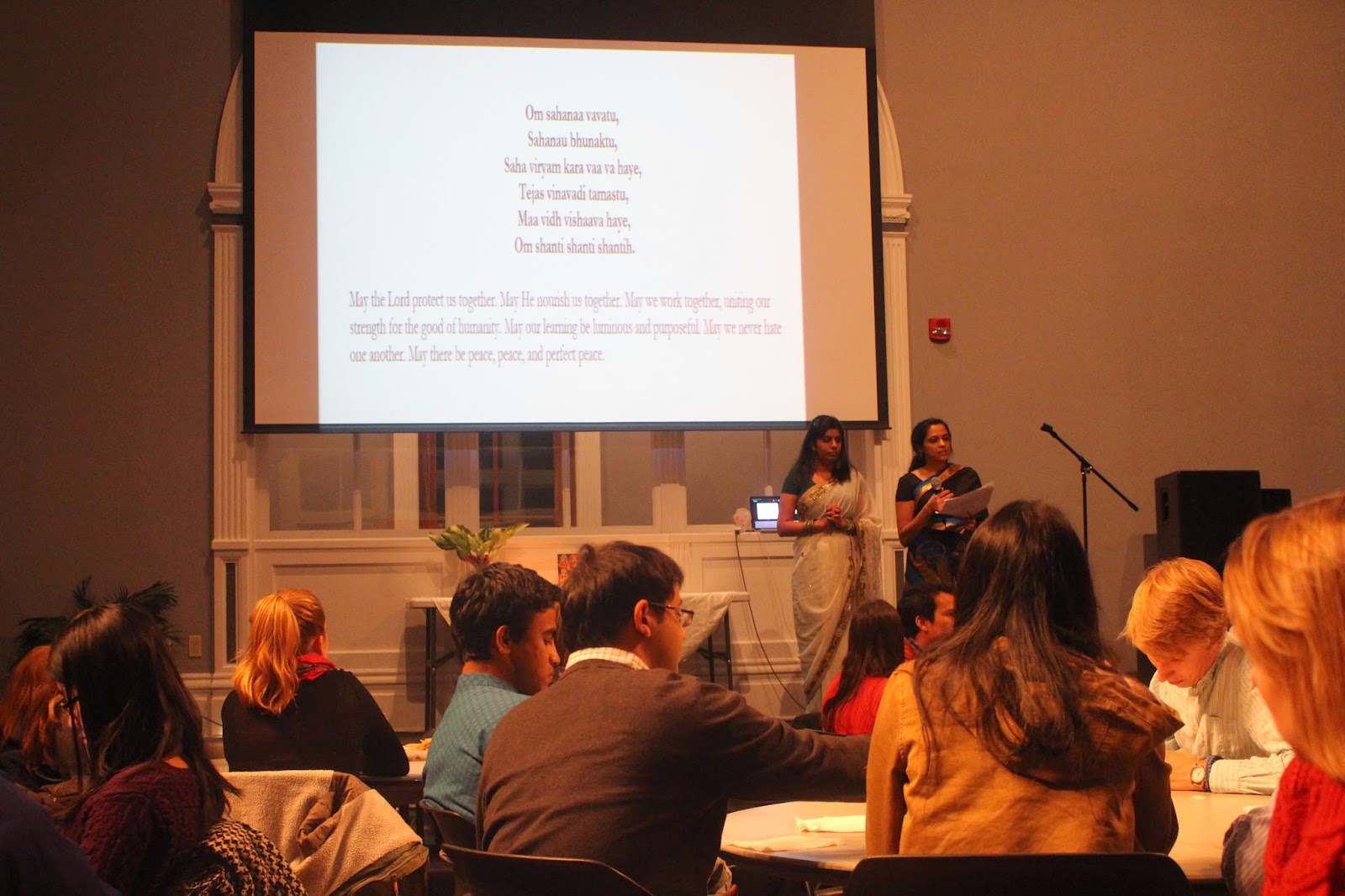


During my last PFATW post, “Let’s Talk Zen,” I wrote about the importance of silence. Looking around the room during our shared meal during Diwali, I found myself reflecting upon a bit of an opposite concept: the significance of community in our faith lives. There is something wonderful and deeply human about joining in community with the ones we love in the simple celebration of life. Diwali acknowledges each individual’s light and goodness while simultaneously bringing people together in community. This reminded me of a quote regarding the nature of human community by Sister Thea Bowman:

“If each one of us would light a candle, we’ve got a tremendous light.”


Breaking bread: it comes in many forms, whether we partake in the Eucharist on Sunday, share naan at a Diwali festival, dine as a family around the table, or have a conversation over sandwiches at South Dining Hall.

How will you break bread this week?

Sources

Tuesday, November 4, 2014

…And With Your Spirit. {Part 2}

The Sign of Peace, as I mentioned last week, has always been a part of Mass that holds great significance for me. It truly serves a healing purpose in my mind, a notion which originated in my family’s treatment of the Sign of Peace as a time to hug one another, even if others around us at our home parish were shaking hands.

In high school, the hugging became the norm: in fact, I am sure visitors to Jesuit High School are shocked at the amount of enthusiastic hugs that are shared during weekly Friday Masses. The Sign of Peace is quite a unique countercultural experience for teenagers at my high school, which was (and is) key to forming the incredible sense of community there. I have that community to thank for so much of who I am today.

So what does the Sign of Peace mean at Notre Dame?

The Sign of Peace at a Ryan Hall retreat
The Congregation of Holy Cross takes as its model the Holy Family of Jesus, Mary, and Joseph.  Speaking to hall staff this past summer, Fr. Pat Reidy, C.S.C. described this familial charism as guiding the residential mission of Notre Dame: 

“Jesus, Mary, and Joseph offer us the model for how any group of people should love each other, united in charity.  Following their model of love, Holy Cross seeks to build communities that attend to one another in struggles, assist one another in good works, and celebrate together in times of joy.  Family isn't necessarily an easy thing for us – it certainly wasn't always for the Holy Family - and yet, it’s precisely the work of our growing into holiness, into wholeness, into the men and women that God created us to be.”

In a very real way, the Sign of Peace is the epitome of the familial atmosphere in our residence halls. It is a time to show one another both that we are a family and that we are loved as individuals. The point is not to prove that one knows everyone in the dorm; the time set aside for the Sign of Peace can, I think, be taken too far. There is a right concern with interrupting the prayerful atmosphere directly after the Our Father, and the community love seems to be taken to an extreme when the priest must practically wrestle people back for the Lamb of God.

But when the Sign of Peace is a nod to the community gathered, flowing from the Eucharist, it serves the function it is meant to in the Mass. “Eucharist” means “Thanksgiving.” Through the Sign of Peace, we reverence Christ’s presence in others as we prepare to share the Eucharist, and allow them to do the same in us.

The Catholic faith is an incarnate faith. In-carnate. Embodied in flesh. Human createdness – incarnational createdness – is expressed very clearly through the physicality of practically everything we do at Mass. We pray with our bodies; we are not just spirits. There is a reason what we do involves water and bread and wine. We hold hands at the Our Father. We represent what is going on at Mass by sitting and standing and kneeling at various points. If we didn’t have bodies, in fact, many ways in which we experience God, such as in nature in things like mountains and sunsets (to give some larger, more typical examples), in a very real way wouldn’t matter.

On this same strain, I love hugs. I know I am not alone in saying that the Sign of Peace would not have the same effect for me if it was constituted by a set of a couple stiff handshakes with the people immediately to my right and left. My cousin, a recent graduate of Notre Dame, commented,

“[During the Sign of Peace] we are wishing that peace and God be with other people who we attend mass with on a pretty frequent basis (whether we actually know them or not). This should be something to hug about!!!” 

While I understand the need to re-evaluate the ways in which the Sign of Peace might more fully meet the faith-based needs of the congregation (as discussed above), I believe it should meet the community-based needs as well. Obviously this will look different for various communities, but I think hugging accomplishes the goal of the Sign of Peace quite well in its current form in most residence halls here on campus.

Before the Church expanded all over the world, parishes used to be made up of one’s family. Our dorms are our homes, and dorm Masses are like celebrating Mass with family. They are our mini parishes. At least in worship, our residence halls are, in a lot of ways, the family and community many parishes are meant to be and hope to create. Rather than making normative a lesser, more formal ideal, why not make normative a community living in the loving image of the Holy Family and strive for that?

While it will clearly vary from parish to parish, region to region and country to country, the Sign of Peace remains both a sign of community shared and a real manifestation of Christ’s unconditional love and peace just before we break bread with one another. It is important, as the Circular Letter points out, to evaluate whether the Sign of Peace meets these goals for each specific community. I would certainly argue that the hug-fest-style Sign of Peace in residence halls at Notre Dame, when done respectfully and reverently, serves just the purpose it is meant to.

May the Peace of Christ be with you.

Monday, October 27, 2014

"Peace Be With You…" {Part 1}


When my two younger brothers and I were little, on Sundays it became a competition to see who got to sit in the two outside seats in the middle row of the family minivan on the way to Mass. The last one to the car would, inevitably, be stuck in the middle seat, where you were subject to poking and teasing from not one sibling, but two. (Of course, now that they’re both taller than me, this ceases to be an issue, as I am simply always the default middle seat passenger.)

Inevitably, our morning car scuffles, no matter how trivial, occasionally carried into Mass. Who got to sit next to mom and dad? Who didn’t? And thus, the atmosphere among the siblings was sometimes tense walking into church. Always, though, the Sign of Peace served to diffuse any leftover hard feelings. Even from a young age, I saw how key this action was in preparing me for the Eucharist.

Now, I am much more aware of the deeper significance of the Sign of Peace. In John 14:27, Jesus encouraged his disciples:“Peace I leave with you; my peace I give to you. I do not give to you as the world gives. Do not let your hearts be troubled, and do not be afraid.”After Jesus’ death and resurrection, in John 20:19, he returns to his friends in their state of fear and despair and reveals himself as the same Christ who died on the cross, the Son of God, the One who consistently acts in and fulfills his character:“Peace be with you.” This is the peace we share at Mass.


The Sign of Peace falls in between the “Our Father,” where we ask the Lord to “forgive us our trespasses as we forgive those who trespass against us,” and the sharing of the gift of the Eucharist. Thus, the Sign of Peace is a continuation of our preparation to receive peace from the Our Father. It serves as the gesture of forgiveness among the congregation that we promise during the Lord’s Prayer as well as a symbol of Christ’s forgiveness that will allow us to approach the altar to receive Jesus’ Body and Blood with clean hearts. During the Eucharistic prayer, we then implore the Lamb of God to share his peace with us. It is all one continual prayer.

During the 2005 debates of the Synod of Bishops on the Eucharist, a question arose regarding whether or not the Sign of Peace as we know it appropriately accomplishes what it is meant to in the Mass. The Congregation for the Divine Worship and the discipline of Sacraments began to examine this issue, and the Vatican released a Circular Letter entitled “The Ritual Expression of the Gift of Peace at Mass” in July which addresses the bishops of the worldwide Church. View the text of the Circular Letter by clicking on the link on this page.

In this Letter, the Vatican explains that the Synod of Bishops discussed the “appropriateness of greater restraint” in the gesture of the Sign of Peace, “which can be exaggerated and cause a certain distraction in the assembly just before the reception of Communion.” The Letter emphasizes the importance of the Sign of Peace, however, especially in a world in such great need of peace, and recommends that bishops around the world consider whether changes be made to the way they currently express the Sign of Peace in their diocese. For example, hugging might be appropriate in one area, where shaking hands might be appropriate in another, where nodding or bowing might be more effective in others.

The Letter makes it clear that all churches should avoid “abuses such as” a song during the Sign of Peace, the movement of the congregation from their original places in the church, and the departure of the priest from the altar to share the Sign of Peace with the congregation.

What would changes to the Sign of Peace mean for the Notre Dame worship community, the Catholic Church of America, and the greater worldwide Church? What specific purposes does the Sign of Peace serve, and how does it go about accomplishing these goals?

Next week, we will continue our discussion of the Sign of Peace, examining these questions and others. I will share my own experiences with the manifestation of peace at Mass both from home in Portland, OR and here at Notre Dame.

In the meantime, what does the Sign of Peace mean to you? How would significant changes to the form alter this meaning?